
The Paintings of Ages Ago
The original production of Ages Ago had no portraits. Rather, there were empty picture frames which remained covered by veils until it came time for the people in them to step out. While Mrs. MacMotherly alludes to the paintings and their subjects in her speech, the audience did not get any visual reference for the characters of Lady Maud, Sir Aubrey, Lord Carnaby, or Dame Cherry until they came to life stepping through the empty frames later in the show.
Perhaps inspired by Ruddigore, it is now common, when Ages Ago is produced, to see the portraits – typically paintings of the cast in costume – on stage before they come to life. Scrims and lighting are used to facilitate the transformation from portrait to actor.
We did not have the means in this production to execute something like that. Our interpretation of the transformation is more figurative, due to our constraints of space and budget. We took the opportunity, however, to, instead of having paintings of our cast which we claim to be by Leonardo, Titian, et al., use images of actual paintings by the actual painters named, and costume our performers to resemble them. Here is a list of the paintings used, and a little bit about them.
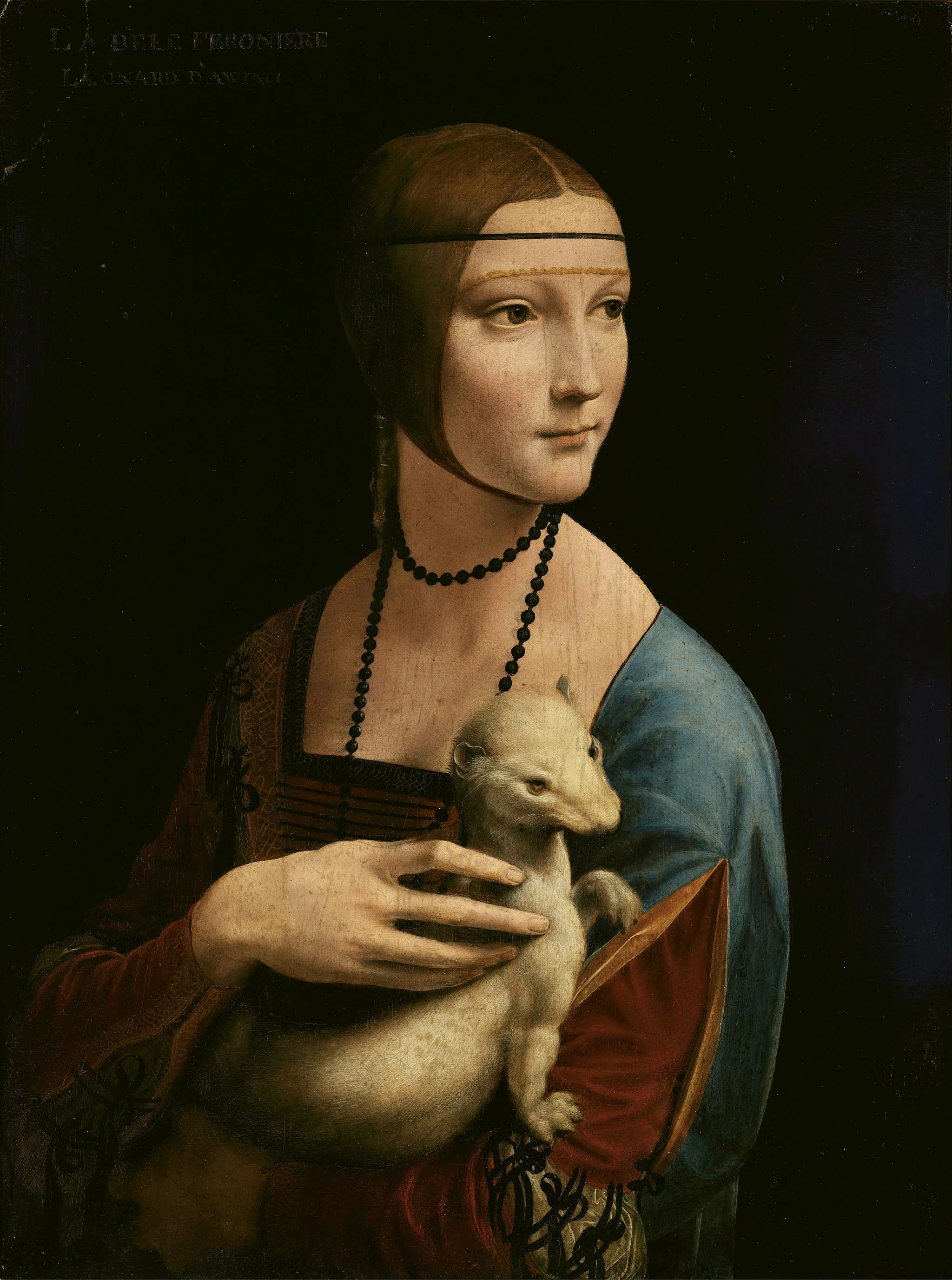
Lady Maud de Bohun (1455 - 1473)
Lady with an Ermine - Leonardo da Vinci
Leonardo da Vinci is easily the most famous painter named in Ages Ago. A literal Renaissance man, he is of course famed for his paintings – though he painted relatively few – but also his drawings and sketches, notebooks with writings on science and philosophy, and his mechanical inventions. Lady Maud claims that Leonardo was “quite an unknown man” when he painted her in 1472, which is true. The 20-year-old Leonardo had at that time not yet achieved great fame. Our choice of Lady with an Ermine, painted around 1490 – exact dates for nearly all of Leonardo’s works are somewhat uncertain – is therefore a bit anachronistic. Our hands were tied, however, by the fact that there exist only four extant portraits of women which are widely attributed to Leonardo. Mona Lisa, the most famous of the four, struck us as being a bit too obvious. Lady with an Ermine, a somewhat more unknown painting – especially in the nineteenth century – might have more plausibly passed unremarked upon hanging in a haunted castle in Scotland in 1869.
The inscription on the top left of the painting reads:
LA BELLE FERONIERE
LEONARDO DAWINCI
This is believed to have been added sometime in the 1800s. The term “Feroniere” refers to the style of headband, which resembles that worn by the woman in another portrait by Leonardo, typically called “La Belle Ferronnière.” This title was also not given by Leonardo himself, but applied by others later. It is debated whether the painting was named after the style of headband, or if the headband was named after the painting. The corollary to the latter hypothesis is that the painting may have been named due to the belief that the subject of the painting was the female relation of an ironmonger – “ferronnière” being the French term for such a person – and that the word subsequently came to refer to the style of headband depicted in the painting.
It was at one time believed that Lady with an Ermine and La Belle Ferronnière depicted the same subject, but this is no longer widely accepted. I would have thought the subject’s upright ears and pointed snout would have made it obvious.
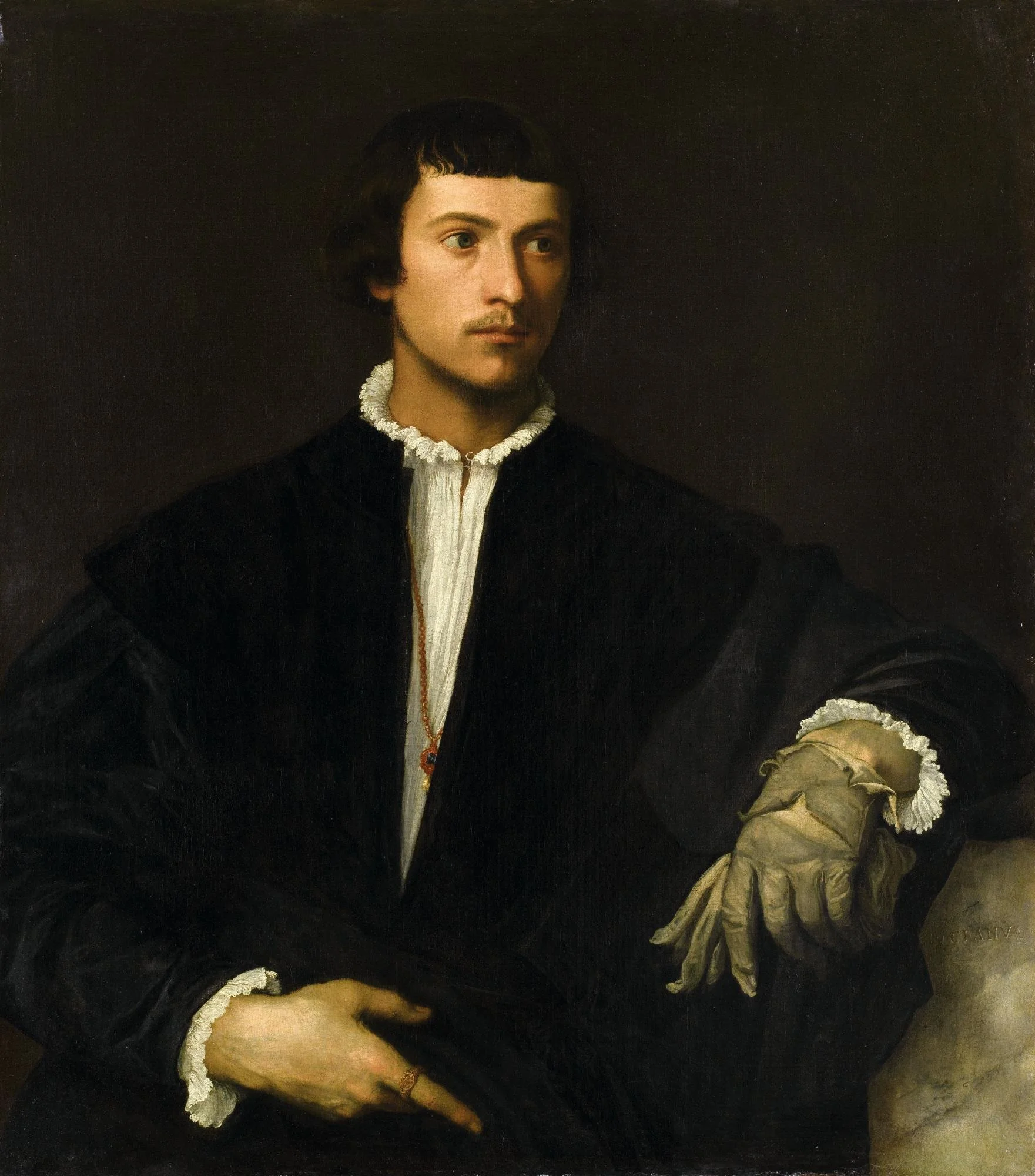
Sir Aubrey de Beaupré (1540 - 1579)
Man with a Glove - Titian
If you have seen or read Ages Ago before, you may be confused by the inclusion of a painting by TItian. In the most commonly available edition of the libretto, the character of Sir Aubrey is named Sir Cecil, and he is stated to have been painted by Michael Angelo[1]. Michael Angelo is the painter named in the 1895 edition of the libretto, and in reviews of productions past 1875, but the first published edition of the libretto – a book of the lyrics which was available for audiences of the original production to purchase – names Titian, as do reviews of the original production. Curiously, Michael Angelo’s name appears in the license copy and other copies of the libretto which likely date to before opening night, and so it appears that Gilbert’s original plan was for Michael Angelo, which he then changed to Titian by opening night, and then reverted back to Michael Angelo for subsequent productions. We have opted to go with Titian for two reasons: First, because we believe it to be accurate to what was performed in the original production, and second, because Michael Angelo did not give us very many extant portraits to choose from. It was far easier to find a painting by Titian which suited our purposes.
Tiziano Vecellio, known more commonly as Titian, was a Renaissance painter of the generation following Leonardo. He is most famous today for his large-scale mythic, religious, and allegorical works, such as the Assumption of the Virgin, a large altarpiece painted for the Santa Maria Gloriosa dei Frari in Venice[2]. But he was also a prolific portrait artist. He painted many notable personages of the day, including Pope Paul III, Emperor Charles V, and King Francis I of France.
Man with a Glove is not a notable personage. The subject is unknown. This made it something of a blank slate for us in this production, but in truth, we selected this painting because of the glove, which was a simple way to costume Sir Aubrey’s discolored hand, which has been restored by a Royal Academician. The painting is dated to around 1520, which is forty years earlier than Sir Aubrey is stated to have been painted.
[1] Productions of Ages Ago will sometimes play it off as a joke when Lady Maud reads “Michael Angelo” off of the inscription, as though, because she dates from a century prior, she does not know better and assumes that “Michelangelo” is two names. In fact, “Michael Angelo” is how the painter’s name was usually written in the nineteenth century, and “Michelangelo” did not become the standard spelling until the twentieth.
[2] The monumental scale of Titian’s most famous paintings may be why Sondheim’s reference to “a tiny Titian” in A Little Night Music is meant to be funny.
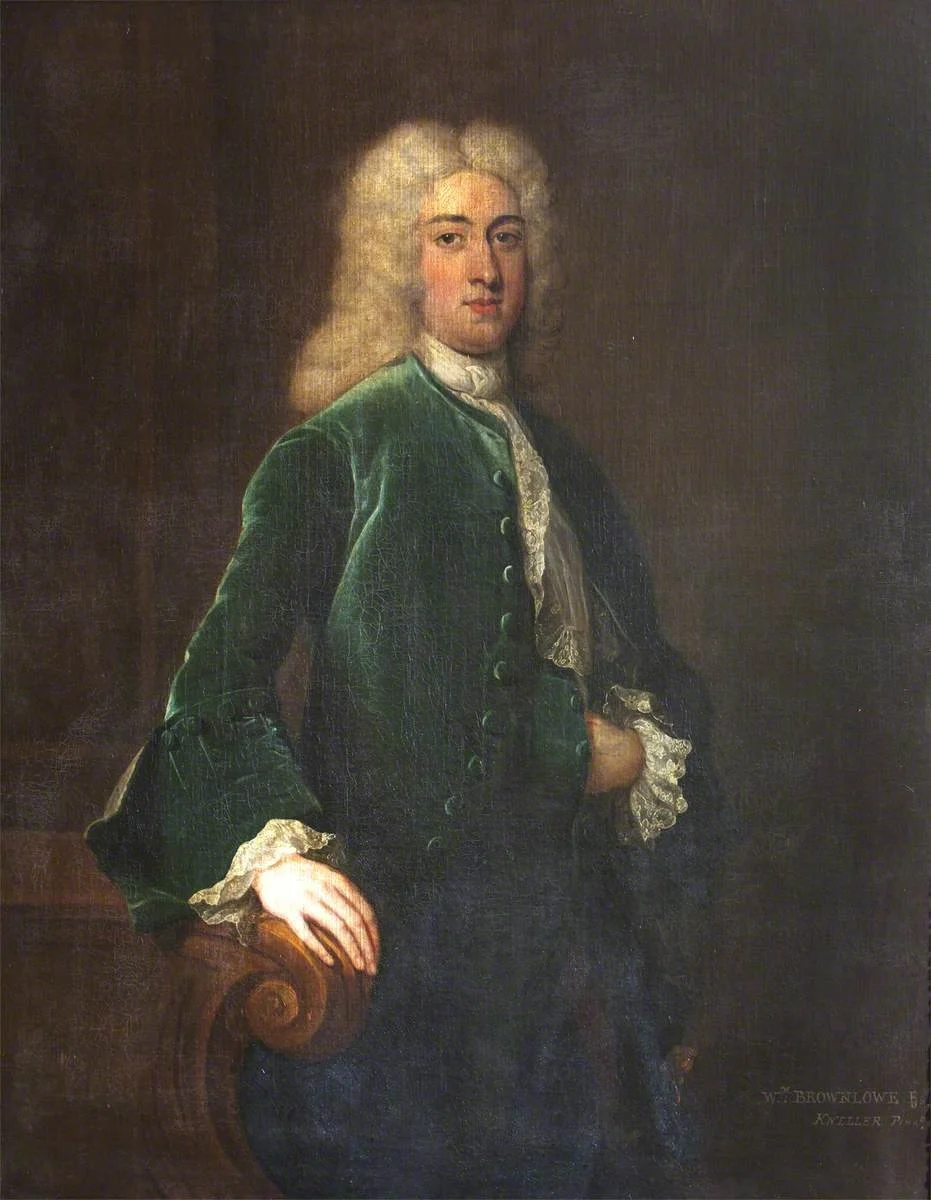
Lord Carnaby Poppytop (1648 - 1720)
William Bronlowe - Sir Godfrey Kneller
Sir Godfrey Kneller is comparatively obscure today, but would have been known to Gilbert’s audience as one of the leading British portrait artists of the late seventeenth and early eighteenth centuries. Born in Lübeck, on the north coast of what is now Germany, Kneller came to England in 1676. He had a rapid rise to fame: First he gained the patronate of James Vernon, the secretary to the Duke of Monmouth. The secretary recommended him to the Duke, and the Duke recommended him to the King. When the chief court painter Sir Peter Lely died in 1680, Kneller took over as the portrait artist of choice to King Charles II’s court. He was appointed Principal Painter in Ordinary to the King in 1689, and subsequently painted every British monarch through George I, who was the last to ascend within Kneller’s lifetime.
Kneller was incredibly prolific, estimated to have painted upwards of 5,000 paintings in his lifetime, and leaving hundreds of portraits unfinished at the time of his death. No wonder then that he would have been familiar to Gilbert’s audience – from volume alone, Kneller portraits must have adorned the walls of so many ancestral homes. Between 1703 and 1720, Kneller painted one of his most famous series of portraits, 42 canvases depicting members of the Kit Kat Club, a social gathering of Whig politicians, noblemen, and others. The canvases, 36” by 27”, were sized to fit the walls of the club’s meeting room in the house of Jacob Tonson, and being slightly longer than the typical half-length portraits of the time, allowed for Kneller to include the subject’s hands in the frame. The term “Kit Kat” came to be used to describe any half-length portrait which also includes one or both of the subject's hands, and could therefore be retroactively applied to both Lady with an Ermine and Man with a Glove.
We have selected this portrait of William Brownlowe, dated 1719, for the simple and pragmatic reason that Richard Holmes, playing the role of Lord Carnaby in this production, already happened to own a green long coat resembling the one in the painting.
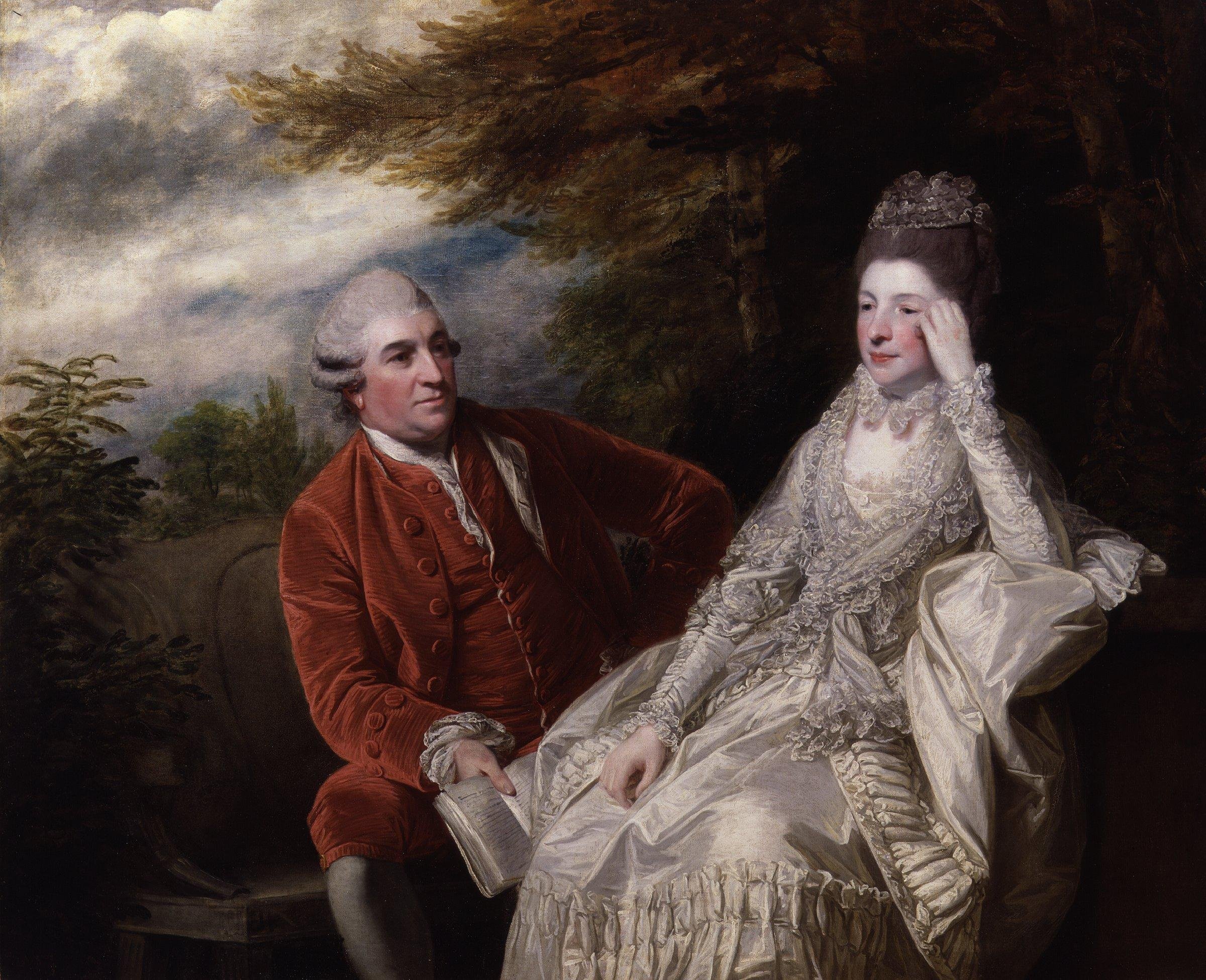
Dame Cherry Maybud (1730 - 1782)
David Garrick and Eva Marie Veigel - Sir Joshua Reynolds
Joshua Reynolds was one of the best-known portrait painters in England in the eighteenth century, and remained famous in Gilbert’s day. Reviews of the original production of Ages Ago refer to “Sir Joshua” with the assumption that the reader would recognize that time as readily as they would Leonardo. Like Kneller before him, he rose to prominence through a series of word-of-mouth recommendations to increasingly high-status personages, also ultimately being appointed Principal Painter in Ordinary to the King – in this instance George III – in 1784.
Reynolds was perhaps as significant an art communicator as he was an artist. He was a founding member and the first president of the Royal Academy, where he also delivered a series of lectures, titled Discourses. The Academy was founded with the intent of advancing arts appreciation and education in the country, but it was also an exclusive club, with a heavily restricted list of members, which positioned itself as the exclusive arbiters of good artistic taste. It may be inferred from certain lines of dialogue in Ages Ago that Gilbert did not think much of the Academy as an institution, suggesting that they would have rejected Leonardo if he was not personally connected.
The portrait by Reynolds we have selected is one of David Garrick and his wife Eva Marie Veigel – we have omitted David Garrick from the portrait seen on stage. Garrick was an actor and theatrical manager, and Veigel was an Austrian-born dancer. They were two of the best-known theatrical personages of the eighteenth century, and the subject of many double portraits. Garrick was a major figure in bringing the plays of Shakespeare back to prominence, and Gilbert certainly would have been familiar with his work. One wonders if Garrick and Veigel may have served as inspiration for the German theatrical manager Ernest and his English bride Julia in The Grand Duke.
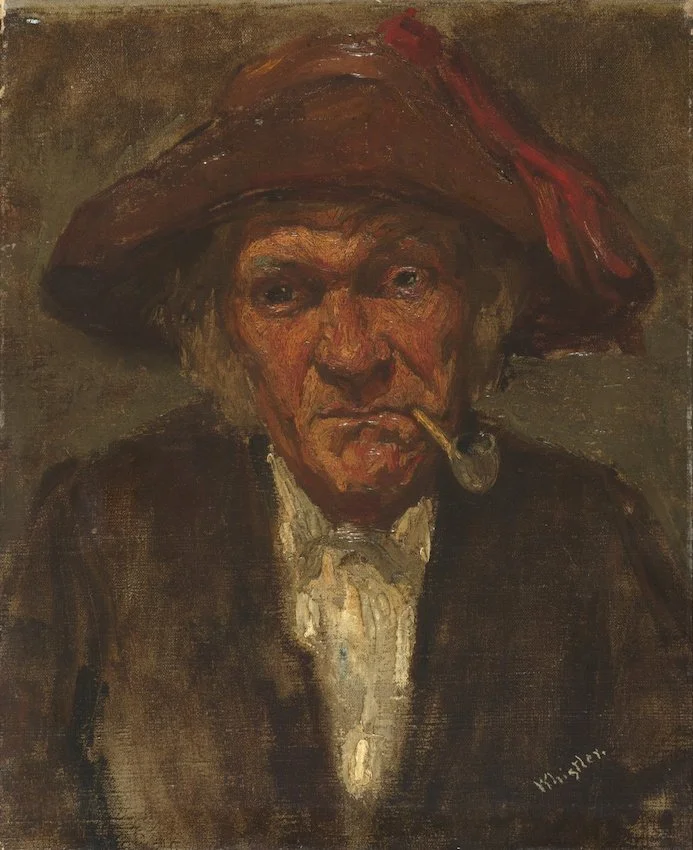
Brown (???? - ????)
Head of an Old Man Smoking - James Abbott McNeill Whistler
Once we had committed to using four real portraits by the actual artists named in the libretto for the four earlier owners of the castle, we had to find a real portrait to stand in for Brown as well.[3]
James Abbott McNeill Whistler was an American-born painter. He spent most of his career based in London, where he was a leading figure of the Aesthetic movement. The Aesthetic movement, known for the slogan “art for art’s sake,” was focused on art created for the sole purpose of being beautiful, without concern for allegory or moral. By the 1880s, aestheticism had become a widespread fad that was a popular subject for parody. Gilbert himself parodied the movement in his and Sullivan’s 1881 opera Patience. Whistler was one of several real-life sources of inspiration for the character of Reginald Bunthrone, with the hairstyle sported by George Grossmith in the original production being a particular point of comparison.
Aestheticism was something of a countercultural movement, and its painters not exactly beloved by the more conservative Royal Academy. Whistler’s painting Nocturne in Black and Gold – The Falling Rocket was exhibited at Grosvenor Gallery in 1877, and was subjected to a brutal review by John Ruskin. Whistler sued Ruskin for libel, and won one farthing in damages, which did not cover Whistler’s legal expenses. Nevertheless, the case caused a scandal[4], and brought a lot of public attention to Whistler as a painter, Aestheticism as a movement, the Grosvenor Gallery as a countercultural alternative to the Royal Academy.
Head of an Old Man Smoking is a relatively early work, from the late 1850s. By 1869, the year Ages Ago is set, Whistler was just about on the cusp of breaking out. Several of his most famous paintings, including a portrait of his mother Anna, date from around this time. It perhaps strains plausibility that Sir Ebenezer Tare would hire this particular painter to paint his maternal grandfather. However, I posit that positioning a painting by Whistler as a more modern outsider against the classical upper-crust portraits is generally in keeping with the plot and themes of the opera.
[3] The Mallett edition of the libretto indicates that brown was painted by one S. Mudge.
[4] It may even have been Ruskin’s harshness as a critic that Gilbert was thinking of when he wrote “and even Mr. Ruskin came and worshiped at his shrine” in a cut song from Iolanthe.
Sources:
James McNeill Whistler, by Ronald Anderson, J. Murray, 1994
Sir Godfrey Kneller and his Times, by Lord Killanin. B.T. Batsford Ltd., 1948
Sir Joshua Reynolds, Pulling, by Frederic Sanders Pulling. London, S. Low, Marston, Searle, & Rivington, 1880
“La Belle Ferronnière” by Leonardo da Vinci, Louvre Guided Tours. 2023
Portrait de femme, dit à tort la Belle Ferronnière, Vincent Delieuvin. Musée du Louvre. 2021
Lady with an Ermine, Dorota Dec, Janusz Wałek, Muzeum Narodowe w Krakowie
Man with a Glove, Tom Gurney, TheHistoryOfArt.org